The room does not announce itself. It is a Geneva living room, plaster walls, herringbone parquet, a marble fireplace that no longer works. What sits against the far wall is not a system assembled for show. It arrived piece by piece, over years, each object chosen because it solved something.
La pièce ne s'annonce pas. C'est un salon genevois, murs en plâtre, parquet à chevrons, une cheminée en marbre qui ne fonctionne plus. Ce qui repose contre le mur du fond n'est pas un système assemblé pour l'effet. Il est arrivé pièce par pièce, au fil des années, chaque objet choisi parce qu'il résolvait quelque chose.
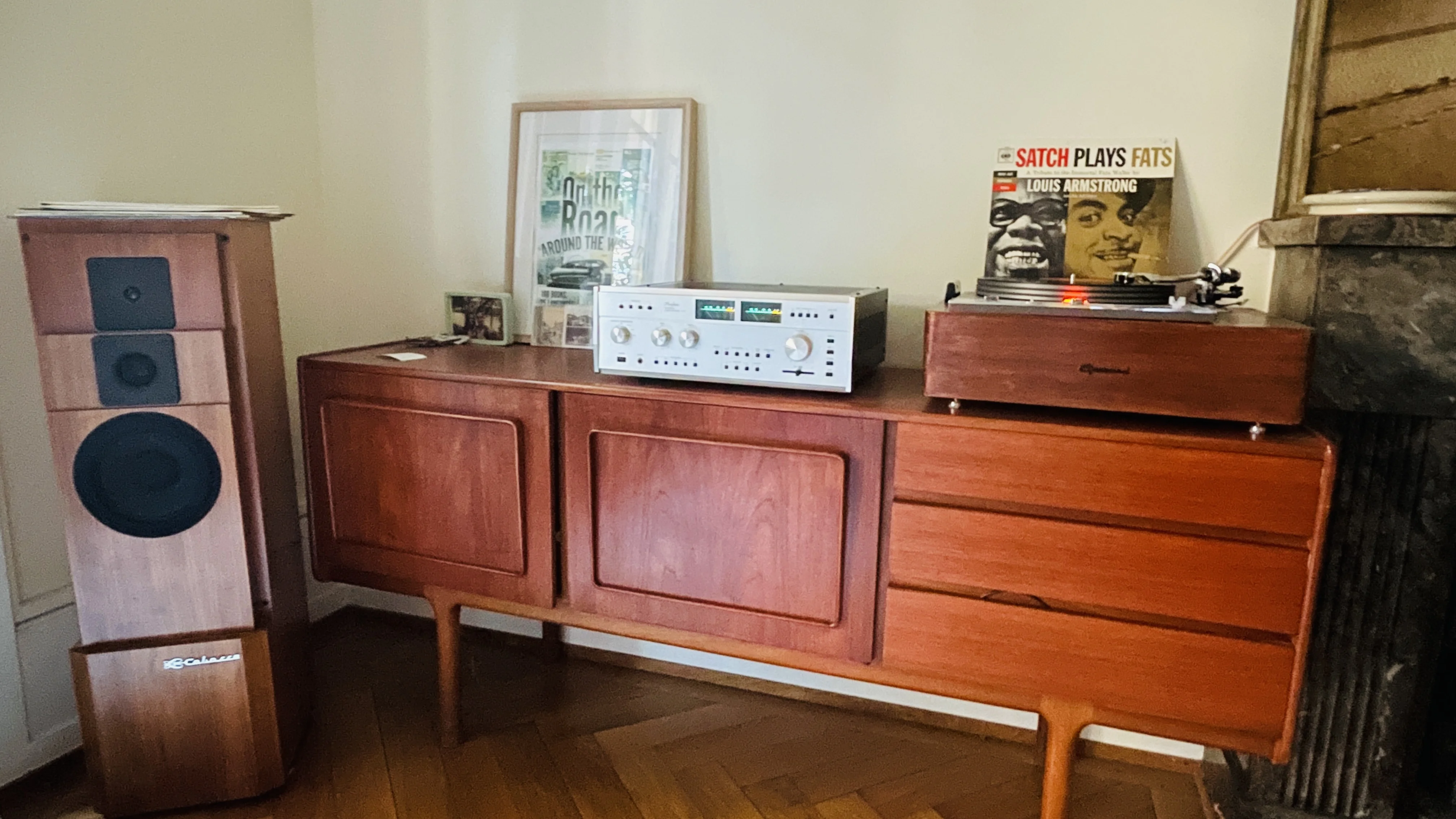
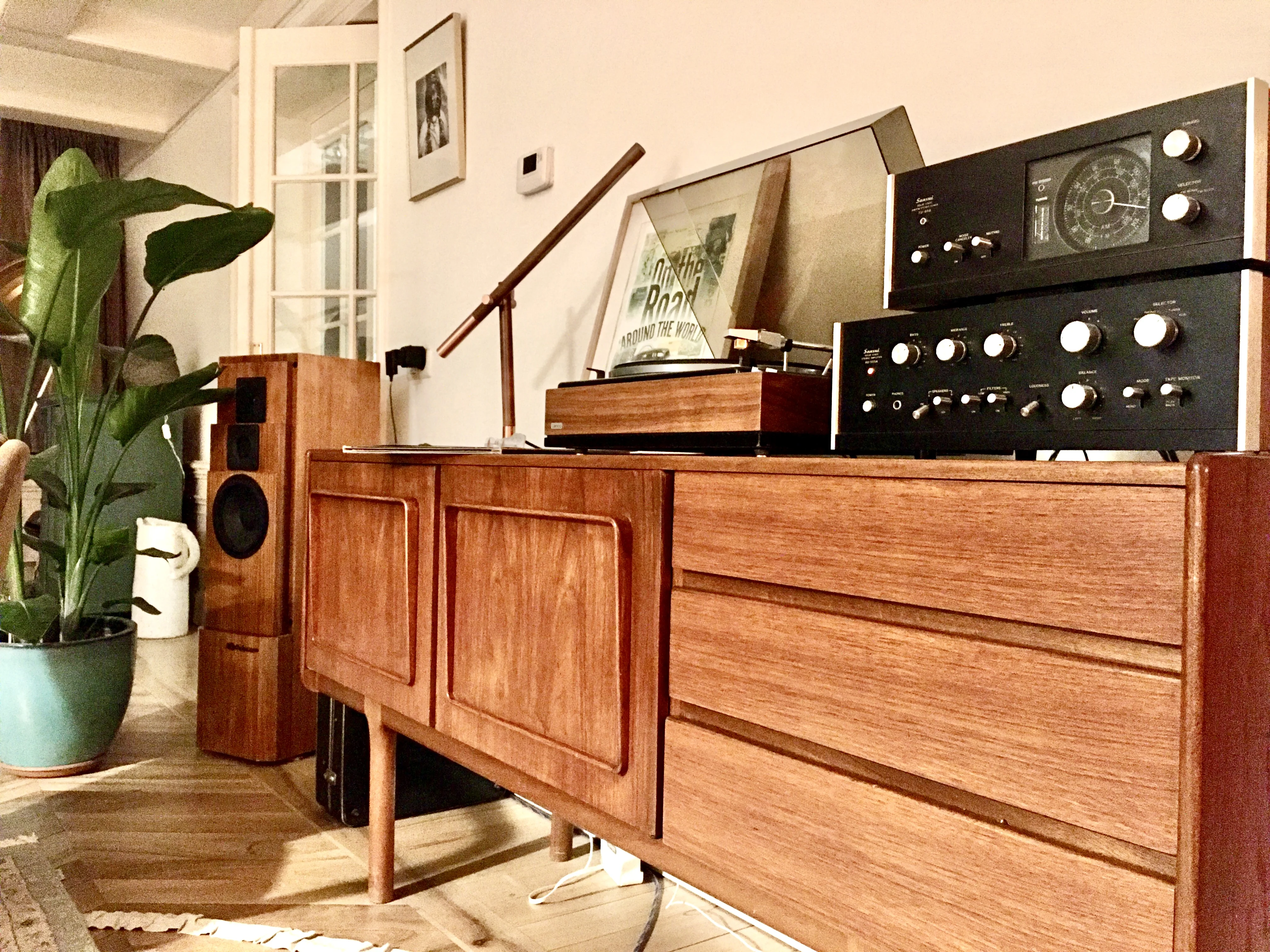
The A.H. McIntosh sideboard came first. Made in Kirkcaldy, Scotland, in the 1960s, under the direction of Tom Robertson, the design director who moved the company from traditional cabinetry toward something closer to Danish Modern without ever quite becoming Scandinavian. Teak, long and low on tapered legs. It is the kind of piece that does not try to disappear. Its grain catches the evening light from the window opposite. The proportions are unhurried. It is furniture that was made with the understanding that a room is not a container but a composition.
Le buffet A.H. McIntosh est arrivé en premier. Fabriqué à Kirkcaldy, en Écosse, dans les années 1960, sous la direction de Tom Robertson, le directeur de design qui a fait passer l'entreprise de l'ébénisterie traditionnelle vers quelque chose de plus proche du Danish Modern, sans jamais tout à fait devenir scandinave. Teck, long et bas sur pieds effilés. C'est le genre de pièce qui ne cherche pas à disparaître. Son veinage capte la lumière du soir venue de la fenêtre d'en face. Les proportions ne sont pas pressées. C'est un meuble fabriqué avec la conviction qu'une pièce n'est pas un contenant mais une composition.
The decision to put the audio system on it rather than on a dedicated rack was not a compromise. It was the whole point. The sideboard weighs enough to resist vibration. Its teak is dense and settled, sixty years of drying behind it. When the Garrard spins, the surface underneath it does not sing back.
La décision d'installer le système audio dessus plutôt que sur un rack dédié n'était pas un compromis. C'était tout l'enjeu. Le buffet pèse assez lourd pour résister aux vibrations. Son teck est dense et stabilisé, avec soixante ans de séchage derrière lui. Quand le Garrard tourne, la surface en dessous ne répond pas en écho.
They inhabit it. There is a difference
most rooms never discover."
Elles l'habitent. Il y a une différence
que la plupart des pièces ne découvrent jamais. »
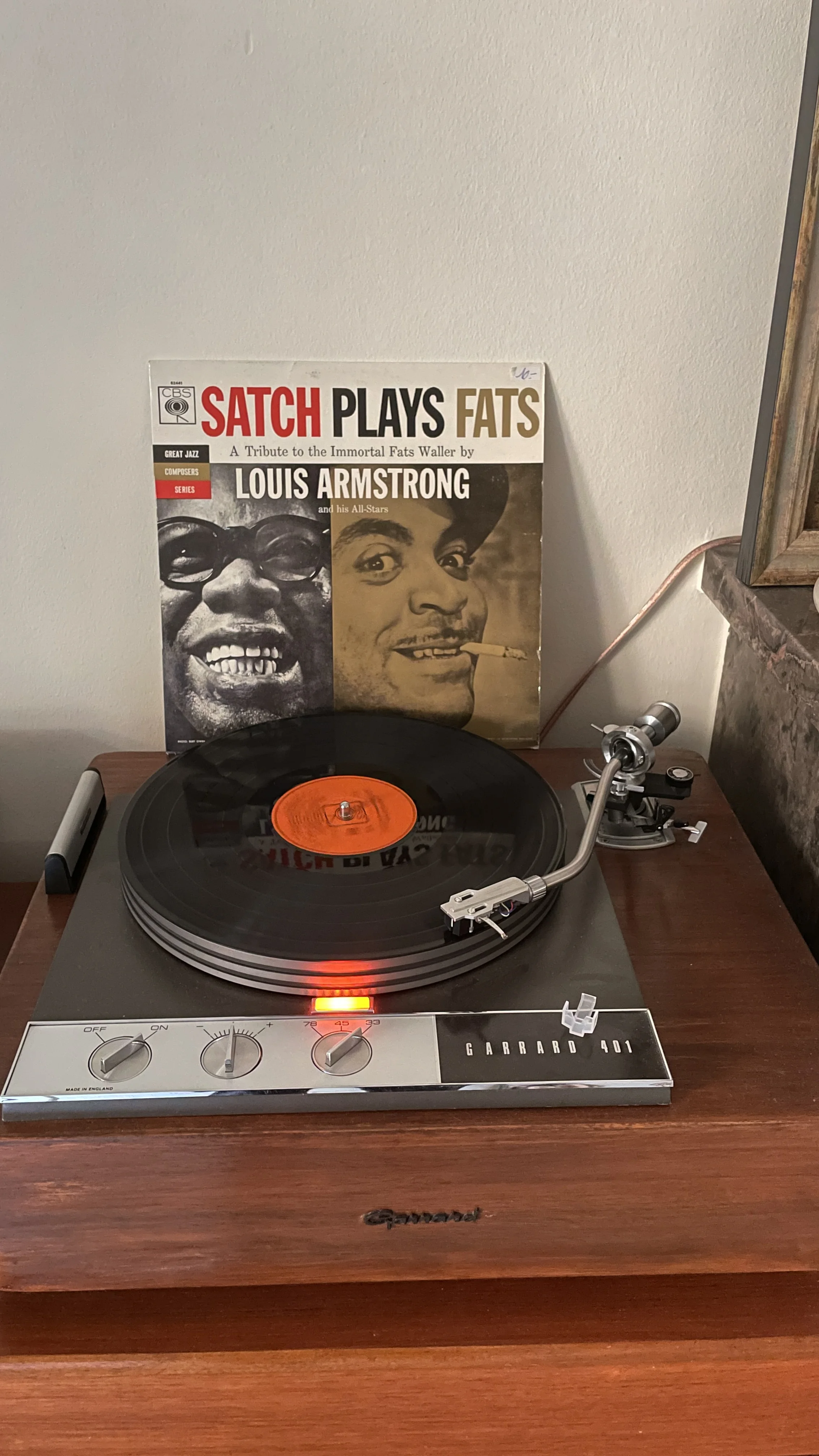
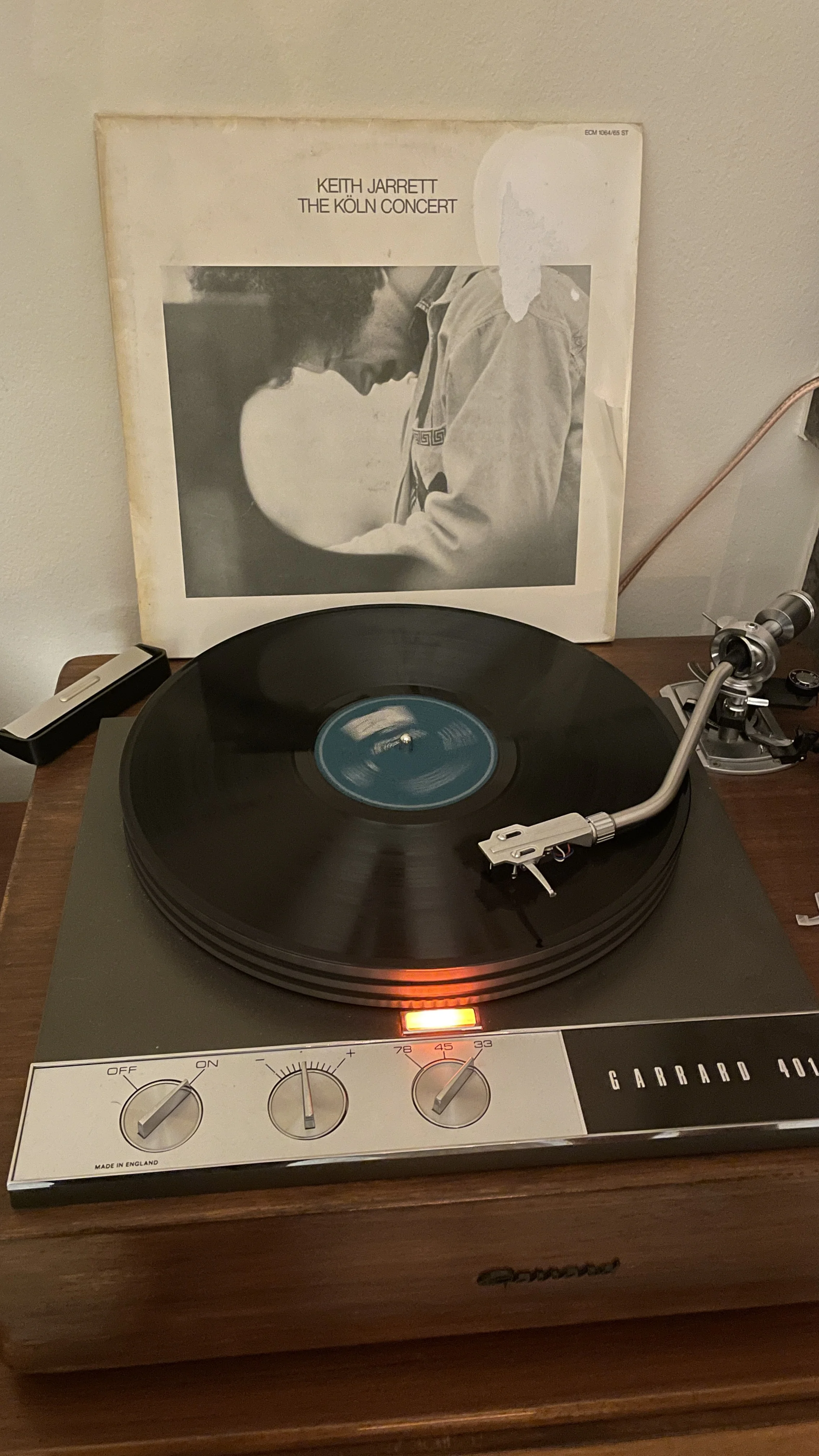
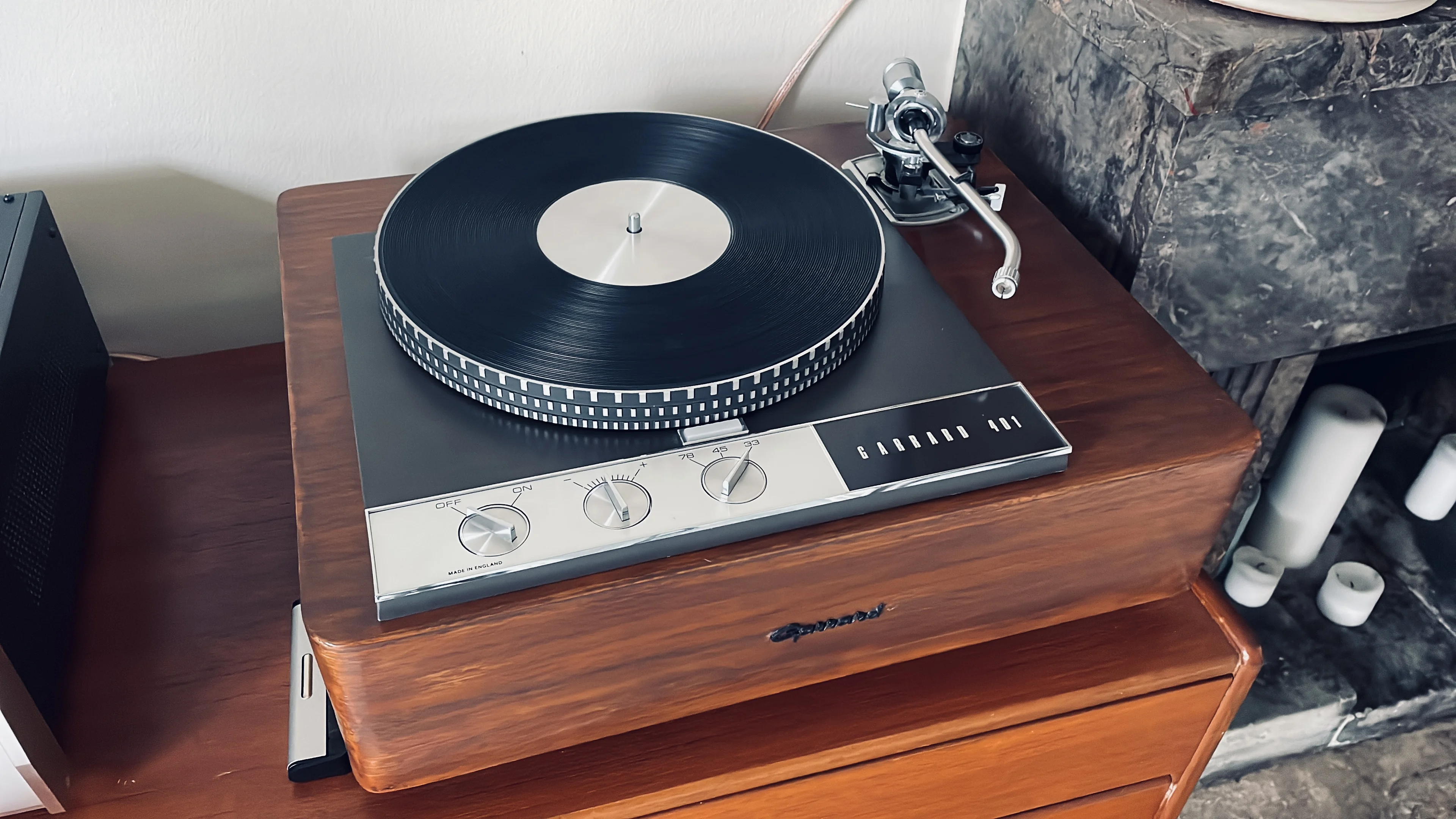
The Garrard 401 was made in Swindon, England, between 1965 and 1976. It is an idler-wheel drive machine: the motor transmits its motion through a rubber wheel pressed against the inner rim of the platter. The engineering is direct, almost blunt. The platter is heavy. The motor is oversized for the task. The result is a grip on the groove that belt-drive machines spend their whole lives trying to approximate.
Le Garrard 401 a été fabriqué à Swindon, en Angleterre, entre 1965 et 1976. C'est une platine à entraînement par galet : le moteur transmet son mouvement par une roue en caoutchouc pressée contre le rebord intérieur du plateau. L'ingénierie est directe, presque brute. Le plateau est lourd. Le moteur est surdimensionné pour la tâche. Le résultat est une prise sur le sillon que les platines à courroie passent toute leur existence à tenter d'approcher.
The arm is an Acos Lustre GST-1, a Japanese nine-inch gimbal-bearing tonearm from the late seventies, with VTA adjustment and a removable headshell. On it sits a Denon DL-103, the moving coil cartridge Denon has been making, essentially unchanged, since 1962, originally for the NHK broadcasting corporation. A conical stylus, low compliance, 0.3 millivolts output. It asks to be loaded carefully and tracked at 2.5 grams. In return it gives you something that more sophisticated cartridges sometimes lose: a kind of directness, a refusal to editorialize. The DL-103 does not flatter the record. It reads it.
Le bras est un Acos Lustre GST-1, un bras japonais de neuf pouces à cardan datant de la fin des années soixante-dix, avec réglage du VTA et coquille amovible. Il porte une Denon DL-103, la cellule à bobine mobile que Denon fabrique, pratiquement inchangée, depuis 1962, conçue à l'origine pour la NHK. Un stylet conique, faible compliance, 0,3 millivolt de sortie. Elle demande à être chargée avec soin et lue à 2,5 grammes. En échange, elle donne quelque chose que les cellules plus sophistiquées perdent parfois : une forme de franchise, un refus de commenter. La DL-103 ne flatte pas le disque. Elle le lit.
The 401 sits in its teak plinth, the Garrard script in silver on the front panel. The orange speed indicator light glows when it runs, a small point of warmth at the edge of the sideboard, like something breathing.
Le 401 repose dans son socle en teck, le logo Garrard en argenté sur la face avant. Le voyant orange de vitesse s'allume quand elle tourne, un petit point de chaleur au bord du buffet, comme quelque chose qui respire.
The Accuphase E-303 was manufactured in Japan in the mid-seventies. Its faceplate is aluminium and black, its VU-meters amber. It is an object that requires no explanation. Anyone who has seen one knows immediately that it was built by people who were not in a hurry and were not trying to reduce costs. The E-303 is what Japanese precision looked like when Japanese precision was still finding its confidence.
L'Accuphase E-303 a été fabriqué au Japon au milieu des années soixante-dix. Sa façade est en aluminium et noir, ses VU-mètres ambrés. C'est un objet qui ne demande aucune explication. Quiconque en a vu un sait immédiatement qu'il a été construit par des gens qui n'étaient pas pressés et ne cherchaient pas à réduire les coûts. L'E-303, c'est à quoi ressemblait la précision japonaise quand la précision japonaise trouvait encore sa confiance.
What it does to the signal from the Garrard before it reaches the Tannoys is difficult to describe without sounding like someone performing enthusiasm. It is simply cleaner and warmer and more present than most amplifiers have any right to be. The meters move with the music. They are not decoration.
Ce qu'il fait au signal venu du Garrard avant qu'il n'atteigne les Tannoy est difficile à décrire sans donner l'impression de jouer l'enthousiasme. C'est simplement plus net, plus chaud et plus présent que la plupart des amplificateurs n'ont le droit de l'être. Les VU-mètres bougent avec la musique. Ce ne sont pas des décorations.
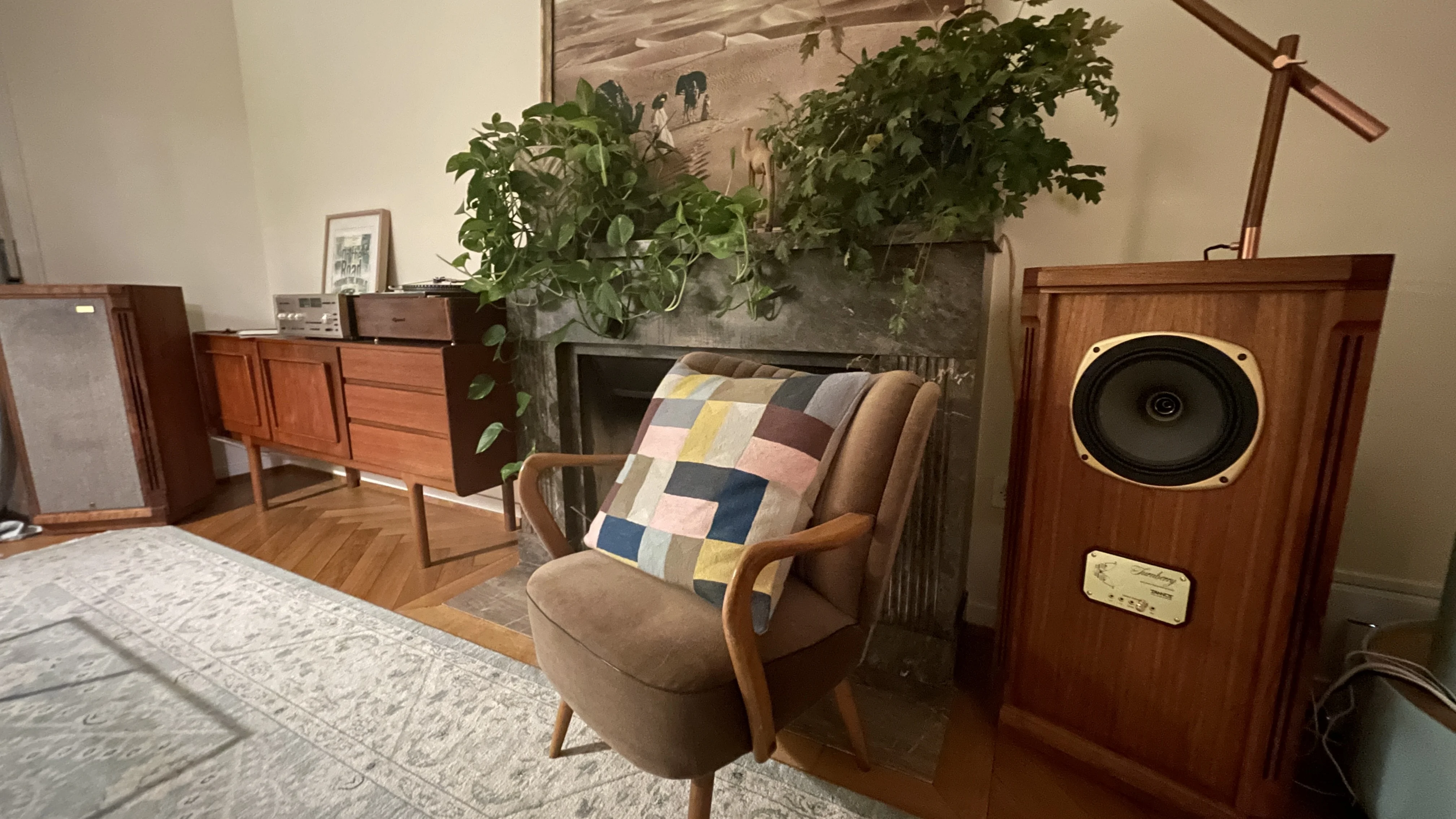
The Tannoys are the thing visitors notice first. They stand at floor level, teak cabinets, the brass nameplate reading "Turnberry" in script. They are the HE version, the Hard Edge series Tannoy introduced in the late nineties within their Prestige range, and they are large in a way that demands a decision: either the room accommodates them or they overwhelm it. In this room, they have been placed with enough space between them and enough distance from the walls that the decision has clearly already been made in their favour.
Les Tannoy sont ce que les visiteurs remarquent en premier. Elles se tiennent au sol, caissons en teck, la plaque en laiton où se lit « Turnberry » en script. Ce sont la version HE, la série Hard Edge que Tannoy a introduite à la fin des années quatre-vingt-dix dans sa gamme Prestige, et elles sont grandes d'une façon qui impose une décision : soit la pièce les accueille, soit elles l'écrasent. Dans cette pièce, elles ont été placées avec assez d'espace entre elles et assez de distance par rapport aux murs pour que la décision ait manifestement déjà été prise en leur faveur.
The Turnberry uses a Dual Concentric driver, the tweeter mounted coaxially at the centre of the woofer cone, an approach Tannoy has maintained since 1947. The result is a point-source image, a sense that the music is arriving from one place rather than being assembled from two separate sources. In a room with herringbone parquet and plaster walls and a fireplace and plants growing across the mantelpiece, that coherence matters. The room already has enough character. The sound does not need to compete with it.
La Turnberry utilise un haut-parleur Dual Concentric, le tweeter monté coaxialement au centre du cône du woofer, une approche que Tannoy maintient depuis 1947. Le résultat est une image ponctuelle, l'impression que la musique arrive d'un seul endroit plutôt que d'être assemblée à partir de deux sources distinctes. Dans une pièce avec parquet à chevrons, murs en plâtre, une cheminée et des plantes qui courent sur le manteau, cette cohérence compte. La pièce a déjà assez de caractère. Le son n'a pas besoin de lui faire concurrence.
The records leaning against the plinth on any given evening are not a statement. They are whatever was decided before the evening began. Harry Belafonte's voice on an RCA pressing from 1956, the room acoustics of Carnegie Hall folded into the groove and released again fifty years later into a Geneva apartment. Louis Armstrong playing Fats Waller, the tuba in the left channel, the cornet slightly right of centre, Satch's voice between them. Keith Jarrett at the Cologne Opera House on January 24, 1975, alone at a Bösendorfer that was too small and badly tuned for the hall, playing for two hours without stopping, the West German ECM pressing catching something of that night that later reissues somehow never quite did.
Les disques appuyés contre le socle un soir donné ne sont pas une déclaration. Ce sont ceux qui ont été choisis avant que la soirée ne commence. La voix de Harry Belafonte sur un pressage RCA de 1956, l'acoustique du Carnegie Hall repliée dans le sillon et libérée à nouveau cinquante ans plus tard dans un appartement genevois. Louis Armstrong jouant Fats Waller, le tuba dans le canal gauche, le cornet légèrement à droite du centre, la voix de Satch entre les deux. Keith Jarrett à l'Opéra de Cologne le 24 janvier 1975, seul devant un Bösendorfer trop petit et mal accordé pour la salle, jouant deux heures sans s'arrêter, le pressage ECM ouest-allemand captant quelque chose de cette nuit-là que les rééditions ultérieures n'ont jamais tout à fait retrouvé.
These are records that ask something of the system they play on. Not technically, not in terms of frequency response or dynamic range. They ask whether the room they enter is ready to receive them. Whether someone has thought about what happens between the stylus and the ear. Whether the furniture is honest, the amplifier warm, the speakers placed where they need to be.
Ce sont des disques qui demandent quelque chose au système sur lequel ils jouent. Pas techniquement, pas en termes de réponse en fréquence ou de dynamique. Ils demandent si la pièce qu'ils rejoignent est prête à les recevoir. Si quelqu'un a réfléchi à ce qui se passe entre le stylet et l'oreille. Si le mobilier est honnête, l'amplificateur chaleureux, les enceintes placées là où elles doivent l'être.
In this room, the answer is yes. Not because the system is expensive or rare or complete. Because someone made a series of decisions, slowly, over time, and the decisions agree with each other. The teak of the McIntosh sideboard and the teak of the Garrard plinth and the teak of the Tannoy cabinets are not a scheme. They are a consequence. The room settled into itself the way a well-chosen record collection does: not by design, but by a consistent set of instincts applied over years.
Dans cette pièce, la réponse est oui. Pas parce que le système est cher, rare ou complet. Parce que quelqu'un a pris une série de décisions, lentement, au fil du temps, et que ces décisions s'accordent entre elles. Le teck du buffet McIntosh, le teck du socle du Garrard et le teck des caissons Tannoy ne sont pas un plan concerté. Ce sont une conséquence. La pièce s'est installée en elle-même comme le fait une collection de disques bien choisie : non pas par un dessein, mais par une constance d'instincts appliqués au fil des années.
The fireplace does not work. The Pothos has been growing across the mantelpiece for two years. The orientalist painting above it shows a desert caravan, figures moving through dunes under a sky the colour of sand. None of these things were chosen for the system. The system was not chosen for them. And yet they belong together, which is the only test that matters.
La cheminée ne fonctionne pas. Le Pothos pousse sur le manteau depuis deux ans. La peinture orientaliste au-dessus montre une caravane dans le désert, des silhouettes traversant des dunes sous un ciel couleur de sable. Rien de tout cela n'a été choisi pour le système. Le système n'a pas été choisi pour eux. Et pourtant ils vont ensemble, ce qui est le seul test qui compte.