Put a turntable on a kitchen table. Then put the same turntable on a solid walnut sideboard, low to the ground, with thirty kilos of mass underneath it. Play the same record. The cartridge, the tonearm, the stylus are identical. The room is the same. The sound is not.
Posez une platine sur une table de cuisine. Puis posez la même platine sur un buffet en noyer massif, bas, avec trente kilos de masse en dessous. Passez le même disque. La cellule, le bras, le stylet sont identiques. La pièce est la même. Le son ne l'est pas.
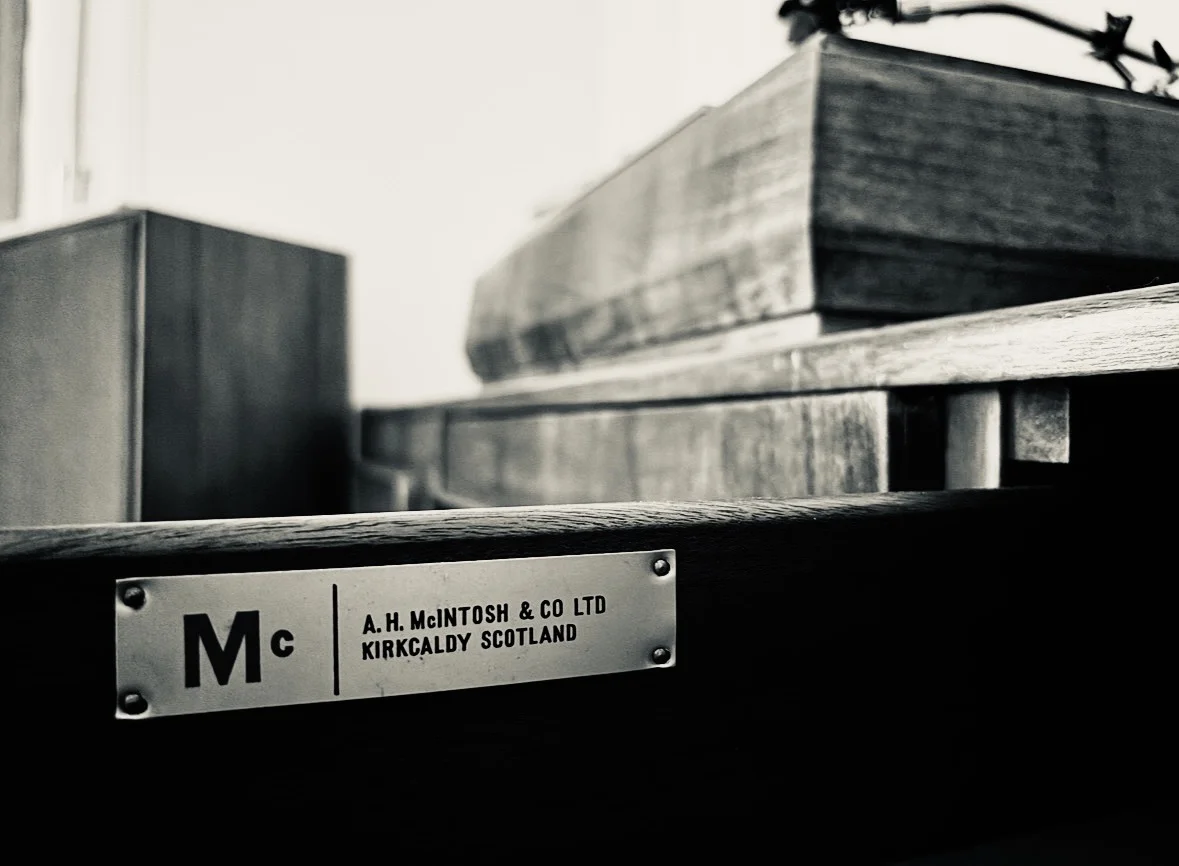
A turntable is a precision instrument measuring movements smaller than a micron. The stylus reads the groove and converts physical motion into an electrical signal. Everything that touches the turntable at that moment is part of the equation. Every vibration transmitted from the floor, through the furniture, into the platter, into the stylus, becomes information the cartridge cannot distinguish from music.
Une platine est un instrument de précision qui mesure des mouvements plus petits qu'un micron. Le stylet lit le sillon et convertit un mouvement physique en signal électrique. Tout ce qui touche la platine à cet instant fait partie de l'équation. Chaque vibration transmise du sol, à travers le meuble, jusqu'au plateau, jusqu'au stylet, devient une information que la cellule ne peut distinguer de la musique.
This is why mass matters. A heavy, rigid surface absorbs and dissipates energy rather than reflecting it back. A sideboard in solid teak or walnut, with proper construction and a few dozen kilos behind it, behaves fundamentally differently from a shelf bracket or a repurposed console table. Not because it looks better. Because it is physically different. The wood damps resonance. The mass resists movement. The result is quieter, more grounded, more present.
C'est pourquoi la masse compte. Une surface lourde et rigide absorbe et dissipe l'énergie plutôt que de la réfléchir. Un buffet en teck ou en noyer massif, correctement construit et avec quelques dizaines de kilos derrière lui, se comporte fondamentalement différemment d'une tablette murale ou d'une console recyclée. Pas parce que c'est plus beau. Parce que c'est physiquement différent. Le bois amortit la résonance. La masse résiste au mouvement. Le résultat est plus silencieux, plus ancré, plus présent.
It is part of the chain, whether you decided it would be or not."
Il fait partie de la chaîne, que vous l'ayez décidé ou non. »
There is a reason every setup that feels right in a photograph shares one quality: the turntable sits low. Not on a shelf at eye level, not on a rack designed for rack-mount equipment. Low, horizontal, in the lower third of the room. This is partly acoustics. The listening position, the speaker axis, the floor reflections all change with height. But it is also something harder to name.
Il y a une raison pour laquelle chaque installation qui semble juste en photo partage une qualité : la platine est basse. Pas sur une étagère à hauteur des yeux, pas sur un rack conçu pour du matériel en baie. Basse, horizontale, dans le tiers inférieur de la pièce. C'est en partie de l'acoustique. La position d'écoute, l'axe des enceintes, les réflexions au sol changent tous avec la hauteur. Mais c'est aussi quelque chose de plus difficile à nommer.
A low setup changes how you relate to the music. You lean toward it. You reach down to lift the needle. The gesture is deliberate, unhurried. A sideboard at 75 to 85 centimetres forces a posture that a shelf at 140 centimetres never would. And visually, the horizontal line of a long low piece of furniture anchors the wall, creates a base for the speakers flanking it, and gives the whole composition a weight that a vertical rack simply cannot offer.
Une installation basse change la façon dont on se rapporte à la musique. On se penche vers elle. On tend la main pour lever l'aiguille. Le geste est délibéré, sans précipitation. Un buffet à 75-85 centimètres impose une posture qu'une étagère à 140 centimètres n'imposerait jamais. Et visuellement, la ligne horizontale d'un meuble long et bas ancre le mur, crée une base pour les enceintes qui l'encadrent, et donne à toute la composition un poids qu'un rack vertical ne peut tout simplement pas offrir.
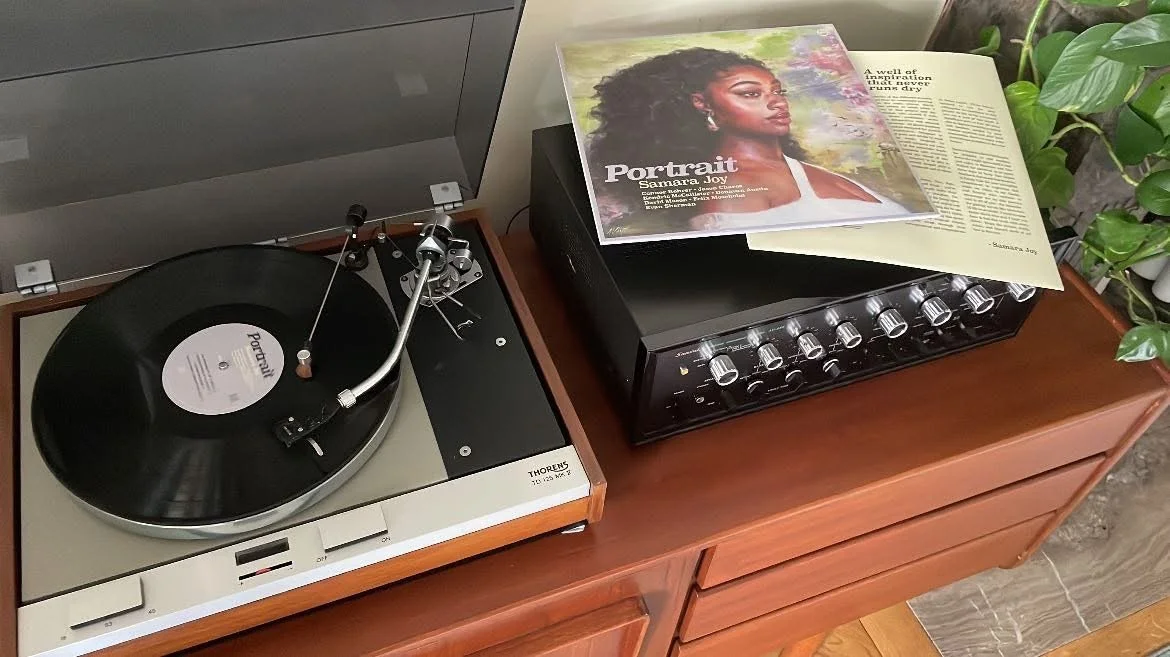
Not all wood is equal, and not all wood is right. Dense hardwoods, walnut, teak, oak, cherry, have different acoustic properties than softwoods or engineered board. They also age differently, look different under light, and feel different under the hand. A teak sideboard from the 1960s has been drying and stabilising for sixty years. Its internal structure is settled. It does not flex, it does not hum, it does not introduce colour into the sound.
Tous les bois ne se valent pas, et tous les bois ne conviennent pas. Les feuillus denses, noyer, teck, chêne, cerisier, ont des propriétés acoustiques différentes des résineux ou des panneaux composites. Ils vieillissent aussi différemment, changent d'aspect sous la lumière, et ne se ressentent pas de la même façon sous la main. Un buffet en teck des années 1960 sèche et se stabilise depuis soixante ans. Sa structure interne est installée. Il ne fléchit pas, il ne bourdonne pas, il n'introduit pas de couleur dans le son.
This is why mid-century Scandinavian furniture became, almost accidentally, the default reference for audio setups built with intention. It was not designed for this purpose. It was designed for a living room in 1962 that happened to share all the same values: honest materials, controlled resonance, long horizontals, purposeful weight. The people who made that furniture and the engineers who built those turntables were, without knowing it, working from the same set of principles.
C'est pourquoi le mobilier scandinave mid-century est devenu, presque par accident, la référence par défaut pour les installations audio pensées avec intention. Il n'a pas été conçu à cette fin. Il a été conçu pour un salon de 1962 qui partageait, sans le savoir, les mêmes valeurs : matériaux honnêtes, résonance contrôlée, longues lignes horizontales, poids délibéré. Les artisans qui fabriquaient ce mobilier et les ingénieurs qui construisaient ces platines travaillaient, sans le savoir, à partir des mêmes principes.
We do not think the furniture has to be vintage. We do not think it has to be Scandinavian. We think it has to be chosen the way everything else in a considered room is chosen: with the understanding that it will change what happens there. Put a great turntable on the wrong surface and you have already made a decision about your sound. Put it on the right one, and the room starts to make sense in a way that goes beyond what you can measure.
Nous ne pensons pas que le meuble doive être vintage. Nous ne pensons pas qu'il doive être scandinave. Nous pensons qu'il doit être choisi comme tout le reste dans une pièce pensée : avec la conscience que ce choix changera ce qui s'y passe. Posez une excellente platine sur la mauvaise surface, et vous avez déjà pris une décision sur votre son. Posez-la sur la bonne, et la pièce commence à prendre sens d'une façon qui dépasse ce que l'on peut mesurer.